Discourses
Teachings preserved by his student Arrian; four books survive.
Four stops in an imagined teaching courtyard: a life, a choice, a shared world, a daily practice.
Enter his courtyard →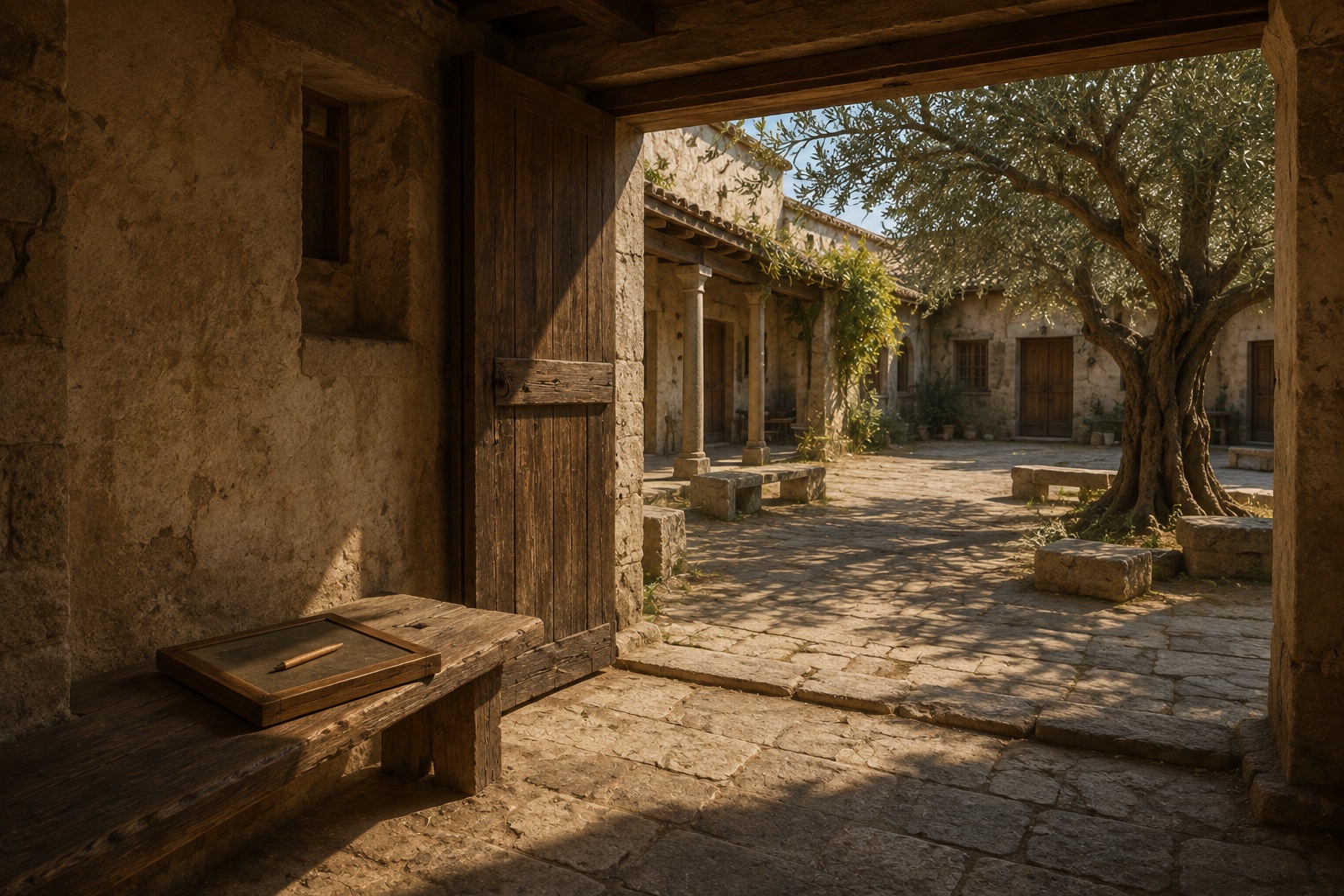
Hierapolis, Roman Empire · c. 50–135 CE
Greek Stoic philosopher and teacher
Explore this tradition and related voices →A practical teacher of inner freedom: distinguish what belongs to your choices from what does not.
Epictetus lived under the Roman Empire and experienced enslavement before becoming a free man and a teacher. His student Arrian preserved his teaching in the Discourses and Handbook. His work asks where our agency lies and how philosophy can become a practice rather than a performance.
Epictetus places ethical freedom in how we judge and respond. Training attention, examining impressions, and fulfilling our responsibilities to others make philosophy a daily practice.
Teachings preserved by his student Arrian; four books survive.
A concise abridgment of the Discourses, compiled by Arrian.
Studies with Musonius Rufus in Rome and eventually gains freedom from enslavement.
Leaves Rome and establishes a school at Nicopolis.
His teaching at Nicopolis becomes the basis of Arrian’s Discourses.
From this voice
Courage begins where certainty ends: with the next honest action that is still yours to take.
Our reflection inspired by Epictetus—not his words.Sirius B reflection on The Handbook, Section 1
Uncertaintylet it flower first, then put forth fruit, and then ripen.
Discourses 1.15
Visit this journey →Discourses 1.15 (excerpt)
In Discourses 1.15, What Philosophy Promises, Epictetus compares cultivating one's character with waiting for a fig to develop. This excerpt is taken verbatim from George Long's translation; it is a metaphor, not a botanical description. The key phrase and reflection are contemporary Alrewaq writing, not words attributed to Epictetus.
Read the source ↗Of things some are in our power, and others are not.
Encheiridion 1
Visit this journey →Encheiridion 1 (opening sentence)
The manual opens with a strict Stoic distinction between our acts and externals; it should not be used to blame people for suffering.
Read the source ↗Of things some are in our power, and others are not.
Encheiridion 1
Visit this journey →Encheiridion 1
The manual opens with a strict Stoic distinction between our acts and externals; it should not be used to blame people for suffering.
Read the source ↗First, say to yourself what you would be; and then do what you have to do.
Discourses 3.23
Visit this journey →Discourses 3.23
Epictetus connects a chosen aim with the actions and training it requires. The chapter challenges philosophy performed for applause rather than put into practice.
Read the source ↗Some things are in our control and others not.
Enchiridion · 1
Visit this journey →Enchiridion · 1
The handbook compiled by Arrian distinguishes our judgments and actions from possessions, reputation, and outcomes. This is a demanding Stoic account of agency, not a promise that feelings are easy to control. It does not excuse oppression or make distress a moral failure.
Read the source ↗The Handbook · Section 1
Prototype paraphrase · not a quotation
Open card →Epictetus connects a chosen aim with the actions and training it requires. The chapter challenges philosophy performed for applause rather than put into practice.
This is about aligning conduct with intention, not a promise that choosing an outcome makes it happen.
Read the original source →